
How slot winning ways are counted: one spin, six paths
Published — UTC

Six winning ways can belong to one stopped grid. The count describes combinations of eligible symbol positions across reels; it does not mean six paid spins occurred or that the screen reveals the probability of the next result.
Label the positions before multiplying
Consider an invented three-reel rule: an A combination uses one A from every reel, beginning on reel 1. Reel 1 shows A at positions a and b; reel 2 shows A at c, d and e; reel 3 shows A at f. Other symbols are irrelevant to this particular count. There are no Wilds, caps or special modes in the example.
The position choices form a Cartesian product, the counting operation described in Python’s product documentation. Our original grid gives 2 × 3 × 1 = 6 paths:
| Starting at a | Starting at b |
|---|---|
| a–c–f | b–c–f |
| a–d–f | b–d–f |
| a–e–f | b–e–f |
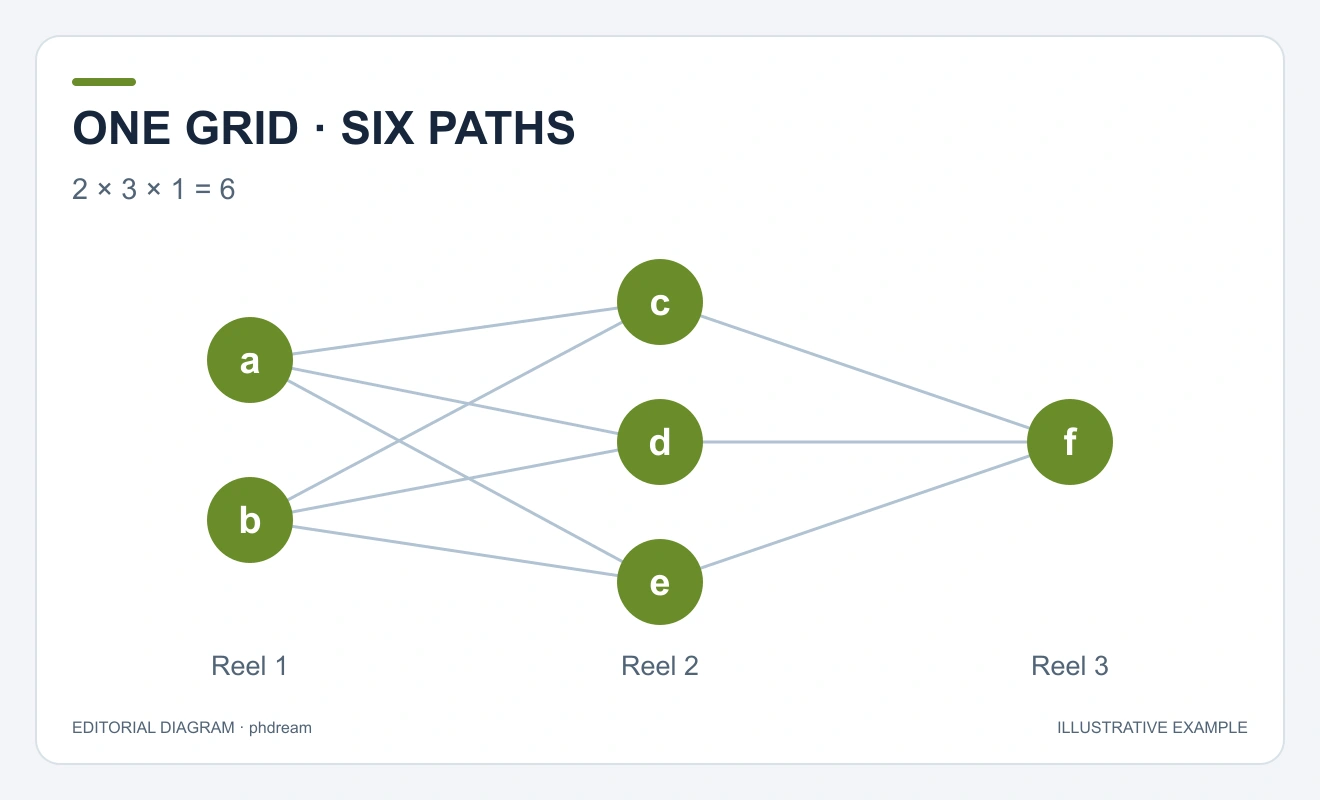
Every path ends at f. That shared position does not make the paths duplicates: their earlier positions differ. Equally, counting f six times in this list does not mean six copies of that symbol exist on the screen.
What happens if one position is removed?
If d is replaced by a non-A symbol, the middle reel has two eligible positions. Four paths remain: a–c–f, a–e–f, b–c–f and b–e–f. The count falls from six to four, although the grid has lost only one A. Counting the total number of A symbols alone would miss that relationship.
Keep the count and the award separate
To calculate money, a real game still needs its exact rules: eligible starting reel, minimum length, per-combination value and any overlapping-combination treatment. A number of paths cannot supply those missing fields. Nor does this example describe how often the fictional grid appears.
First check what the displayed ways number means
A game may show the number of possible combinations for its current reel layout. That is not necessarily the number of winning combinations in the stopped result. Our six-path example counts only the eligible A positions under the invented rule, so it cannot be used as a universal formula for every number labelled “ways.”
In a variable-reel mechanism, the layout itself can change. Big Time Gaming describes Megaways as a system that varies the number of symbols across reels. That developer description establishes the changing-layout principle; it does not turn the small three-reel diagram here into a Megaways paytable.
Why a gap matters more than the total symbol count
Remove every eligible A from reel 2 in our example. The count becomes 2 × 0 × 1 = 0, even though A symbols remain on reels 1 and 3. Counting three visible As would miss the broken sequence. Conversely, removing one A from a reel with several eligible positions may leave some paths intact.
Use the actual game’s rule screen to finish the check
- Identify the required starting reel and minimum consecutive length.
- Check whether Wilds substitute for this symbol and whether any position is excluded.
- Read how longer matches, simultaneous matches and multipliers are paid.
- Keep the displayed total bet and any per-way or per-line stake definition with the paytable.
If the rule needed for one of those steps is absent, stop at a count of the visible positions. Do not convert that count into a payout, RTP or chance of winning. A useful record separates the grid, the rule used to interpret it and the confirmed award.