
Seven lottery selections, three drawn matches: how many lines contain all three?
If a seven-number selection is expanded into every six-number line, it contains seven lines. When exactly three of the selected numbers match a six-number draw, four of those lines contain all three matching numbers. The other three lines each omit one of the matches.
The question is about the contents of the lines. It does not establish that every such line qualifies for a prize under a particular lottery’s rules.
Label matches before counting lines
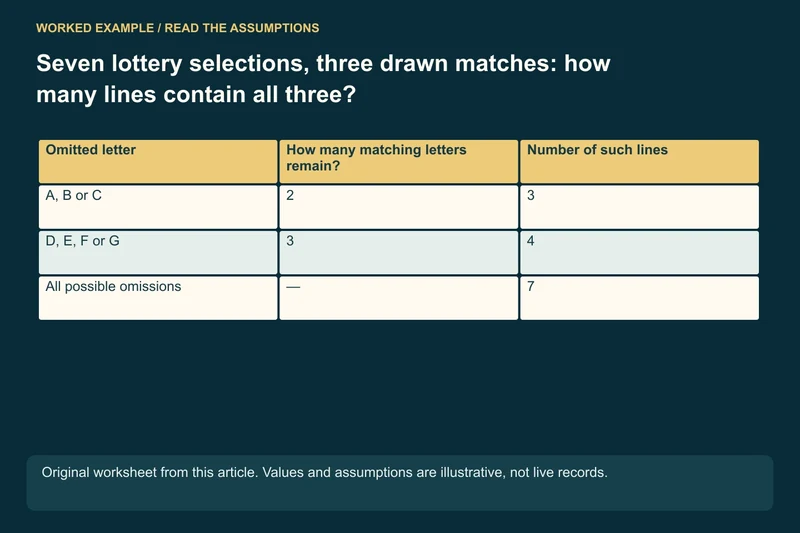
Use an invented selected set {A, B, C, D, E, F, G}. Assume exactly A, B and C match the draw; D, E, F and G do not. The OpenStax combination method explains how choosing objects differs from arranging them. Here each six-number line is formed by omitting one of the seven letters.
No probabilities or actual results are needed. We are counting the lines after supplying the match labels.
Inspect the omitted number
| Omitted letter | How many matching letters remain? | Number of such lines |
|---|---|---|
| A, B or C | 2 | 3 |
| D, E, F or G | 3 | 4 |
| All possible omissions | — | 7 |
To retain all three matches, omit one of the four nonmatching letters. That gives four lines. For example, omitting D leaves A B C E F G, which contains A, B and C. Omitting A leaves B C D E F G, which contains only B and C.
A formula gives the same answer
A line with exactly three matches must choose all three matching letters and three of the four nonmatching letters: C(3,3) × C(4,3) = 1 × 4 = 4. The formula is a check on the omission explanation, not a separate set of extra lines.
Change the assumption to four matching letters among seven. Omitting a match then leaves three matches, giving four lines; omitting a nonmatch leaves four matches, giving three lines. The total remains seven, but the match categories change.
Do not multiply every line by the best category
A seven-line system does not mean all seven lines have the same number of matches. Apply the product’s actual prize conditions to each relevant category only after the line counts are established. A displayed total for the system may already include those components.
For a record check, retain the original seven selections, complete draw set and product identity. If the selected set contains duplicates or does not represent all six-number combinations, this seven-omission model is not the right one. The calculation describes the stated structure without promising a payout or recommending more entries.
The phdream homepage brings together the site’s other reading topics.
Source-based editorial research and original examples. Sources checked 9 October 2026. No real-money play or account transaction was performed for this article.